
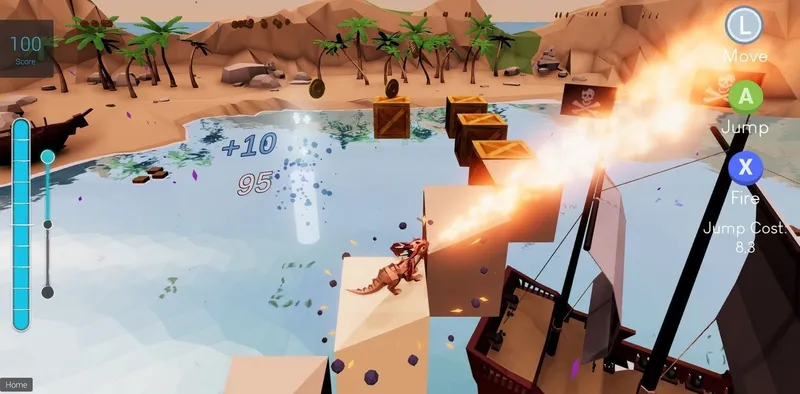
Saturday, 8 July, is Video Games Day. To mark the occasion, today we’re telling you about our neurofeedback games, ALL of which we have developed in-house. In recent years, interest in mental training has increased significantly. Many people are looking for innovative ways to improve their concentration, relaxation and mental performance. One popular method for this is neurofeedback training, which we offer at our practice.
Neurofeedback games are special video games or applications that are based on the principle of operant conditioning and make it possible to visualise unconscious processes. Here is a brief recap of what neurofeedback is: neurofeedback is a method in which brain activity is measured and analysed. To do this, electrodes are placed on the scalp to record the electrical activity of the brain.
Training goals such as concentration, relaxation, focus, etc. can then be defined. The level of difficulty is then adjusted individually for each trainee.
Based on this, specific thresholds are set, and the trainee then receives immediate feedback in the form of the neurofeedback game (e.g. a louder or softer sound).
In a neurofeedback game, the player thus receives real-time feedback on their brain activity. Depending on whether the preset thresholds of the respective frequency bands are exceeded or not reached, the speed of the game changes, for example, or special rewards are unlocked. In this way, the player learns to consciously control their brain activity and to train certain patterns.
Therapy method for ADHD / ADD
Neurofeedback games are often used as a therapy method, for example to help with attention deficit hyperactivity disorder (ADHD) or anxiety. However, they can also be used in the field of peak performance to enhance performance or promote relaxation.
One example of such a game is a flight simulator, in which the player controls a virtual plane with their brain. When the trainee reaches a relaxed, concentrated state, the plane flies, whereas it stops in the event of stress or distraction. Through this direct feedback, the brain implicitly learns to regulate its own activity and, for example, to maintain concentration for longer.
Neurofeedback games offer many advantages:
Training of this kind is extremely motivating. Playing a game is an enjoyable activity for most people, and the prospect of increasing their mental performance through it boosts motivation even further. This is particularly interesting when training children and young people, who often find it difficult to get excited about conventional training methods.
Another advantage is the adaptability of the games. Every player has different strengths and weaknesses in terms of their brain activity. This can be compared a little to weights in the gym – not everyone can lift the same weight, and not every exercise is suitable for everyone.
Neurofeedback games can be tailored individually to the needs and goals of the player – whether the aim is to improve concentration, promote relaxation or train memory. We have developed a total of 15 neuro-responsive games, so there is sure to be something for every taste. Our patients are also welcome to give us feedback on the gaming experience, which we try to implement wherever possible.
Several studies have already demonstrated the effectiveness of neurofeedback games. An analysis of the available data has shown that neurofeedback training can lead to significant improvements in attention, concentration and cognitive abilities. These results are promising and give hope that the acceptance and use of neurofeedback games in mental training will continue to grow in the future.
Feel free to visit our BrainAssistant website to get an overview of all our different games and the software in general.