
Resilience – a modern buzzword that returns a whole 10 million results on Google. But what exactly do we mean by this term, which has been heard more and more often lately? And what effects does resilience have on our brain?
A high level of resilience is almost a superpower – a skill that helps us to tackle challenges more calmly and to regain our balance more quickly. This includes factors such as the ability to cope with pressure, flexibility, optimism, self-efficacy and also the ability to accept support.
Resilience can be learned and is therefore not a static trait that one either has or does not have. Rather, it is a process that constantly evolves over the course of one’s life. Both internal factors, such as personal strengths, and external factors, such as the social environment, play an important role here.
In addition, resilience also contributes to the prevention of mental illness, such as depression.
Prof. Dr. Lieb from the Leibniz Institute for Resilience Research defines resilience as follows: “The maintenance or rapid restoration of mental health during or after stressful life events.”
Basically, resilience describes how well our resources enable us to withstand pressure, to perceive it as less of a burden and to be more resistant to stress. Stressors can be, for example, deadlines, tasks, problems, noise and physical demands. Psychological stresses such as negative thoughts, traumas or setbacks can also play a role. When several stresses add up, the stress level keeps rising.
But what does that have to do with our brain?
Since the brain itself cannot feel pain, overload and states of exhaustion become visible via other symptoms such as sleep problems, circling thoughts, concentration problems, listlessness and loss of joy. These are all things we definitely want to avoid.
More resilience = less overload
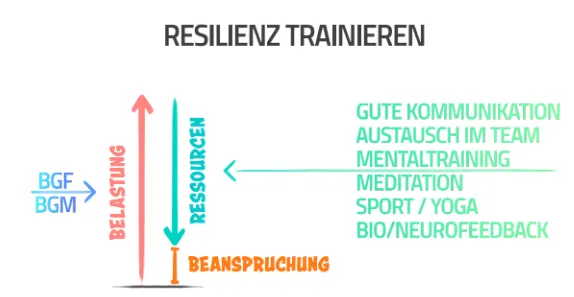
So how do we actually manage to become more resilient, build up our resources and feel less stress? We now know that resilience can be trained. For example, good communication, exchange within the team, mental training, meditation, sports/yoga, and bio/neurofeedback can help us strengthen our resources and become more resilient. Through regular training and building up a certain robustness, we gain the ability to better withstand stress. We find it easier to deal with difficult situations, setbacks or bad news and we can better control our reactions.
You can also find more tips and training recommendations, for example, in our training book for mental fitness and health (available here: neuro-store.com).
So, do you feel like strengthening your resilience? Then take our tips to heart and get started today!